Neighbourhood · · 7 min read
The White City on Foot: A Bauhaus Walk from HaYarkon 45
Discover Tel Aviv's UNESCO-listed White City on a self-guided Bauhaus walk from HaYarkon 45: Bialik Square, Rothschild Boulevard and Dizengoff Square.
Step out of our front door on HaYarkon Street and you are already on the edge of one of the most remarkable architectural ensembles of the twentieth century. Tel Aviv's White City — thousands of pale, clean-lined apartment buildings from the 1930s onwards — is a UNESCO World Heritage Site, and the best way to understand it is simply to walk through it. This guide gives you the background and a relaxed self-guided route that starts and ends at HaYarkon 45.
What is the White City?
In 2003, UNESCO inscribed the "White City of Tel-Aviv – the Modern Movement" on its World Heritage List. According to the UNESCO World Heritage Centre, Tel Aviv was founded in 1909 and the White City was built from the early 1930s until the 1950s, following an urban plan by the Scottish planner Sir Patrick Geddes (1925–27). UNESCO describes it as an outstanding example of Modern Movement architecture and town planning, adapted to the local climate and culture.
The listed property is made up of three zones: the central White City, the Lev Ha'ir and Rothschild Boulevard area, and the Bialik area — all of which you will pass through on the walk below.
The Tel Aviv-Yafo Municipality puts the number of International Style buildings constructed here from the 1930s until 1948 at about 4,000, and calls it the world's largest grouping of buildings in the style popularly known as "Bauhaus".
Why "Bauhaus"?
Strictly speaking, Bauhaus was a design school, founded by Walter Gropius in Weimar in 1919. Many of the architects who shaped Tel Aviv had studied there or under its influence, and, as the municipality notes, a large number arrived after fleeing Europe when the Nazis rose to power. UNESCO stresses that these architects, trained and practising in various European countries, brought a plurality of modernist ideas rather than a single doctrine — which is why "International Style" is the more precise term.
What makes Tel Aviv special is how those ideas were adapted to a hot, bright Mediterranean city. As The Times of Israel reported for the Bauhaus centenary, architects here used less glass to keep out the heat and added balconies to catch the sea breeze.
What to look for
The municipality lists the signature details you will start spotting everywhere:
- Flat roofs — many of them now used as rooftop terraces
- White or pale rendered walls
- Horizontal strip windows and deep, shading balconies
- Pillars (pilotis) lifting buildings off the ground
- Rounded corners, pipe-rail banisters and glass-brick stairwells
Once you know the vocabulary, an ordinary street becomes an open-air museum.
A self-guided walk from HaYarkon 45
This loop covers roughly 5 km. Allow two and a half to three hours with stops, or split it over two mornings. Distances and times below are approximate.
1. Allenby Street to Bialik Street (about 10 minutes)
From HaYarkon 45, Allenby Street begins just steps away, beside the Opera Tower. Walk inland along Allenby and turn left onto Bialik Street, a quiet, tree-lined street that ends at a small, much-loved square.
2. Bialik Square and the Liebling House
Bialik Square sits within one of the three UNESCO zones. Here you'll find the Max Liebling House at 29 Idelson Street, a 1936 building designed by architect Dov Karmi for Tony and Max Liebling. Today it hosts the White City Center, co-founded by the Tel Aviv-Yafo Municipality and the German government to preserve the city's International Style heritage, according to the municipality. Opening hours vary, so check before you go.
Around the corner is the house of the national poet Haim Nachman Bialik — a far more ornate building that makes a striking contrast with the sober lines of the Liebling House.
3. Rothschild Boulevard (about 15 minutes, then a long stroll)
Head back to Allenby and continue southeast until it crosses Rothschild Boulevard. The municipality calls walking along and around Rothschild the best way to experience the White City, and many buildings here have been restored to their original appearance. Follow the shaded central promenade north towards Habima Square, stopping at the kiosks and cafés along the way. Look up: balconies, stairwell windows and rounded corners are the details that reward attention.
4. Dizengoff Street, the Bauhaus Center and Dizengoff Square (about 10–15 minutes)
From Habima, follow Dizengoff Street north. At number 77 you'll find the Bauhaus Center, a private gallery and bookshop founded in 2000 that promotes the White City and offers audio-guided walks. Its guided tours have been suspended at times, so call ahead or check its website for the current programme.
A few steps further is Dizengoff Square. According to Time Out Israel, the young architect Genia Averbuch won the competition to design it in 1934, and the square's original International Style design has since been restored. The Times of Israel singles out the Hotel Cinema building on the square as one of its Bauhaus landmarks.
5. Back to the sea (about 15 minutes)
From the square, walk west along Frishman or Gordon Street to the seafront and stroll south along the promenade back to HaYarkon 45 — ideally around sunset.
Practical tips
- Go early or late. Tel Aviv's sun is strong; mornings and late afternoons are the most comfortable, and the light on the white façades is at its best.
- Respect residents. Most of these buildings are private homes. Admire from the street and don't enter lobbies uninvited.
- Bring water and comfortable shoes, and don't be afraid to detour down side streets — some of the best examples are on the quietest blocks.
- Want more depth? The White City Center and the Bauhaus Center both offer ways to dig deeper; check their current opening hours before visiting.
Staying at 45Beach
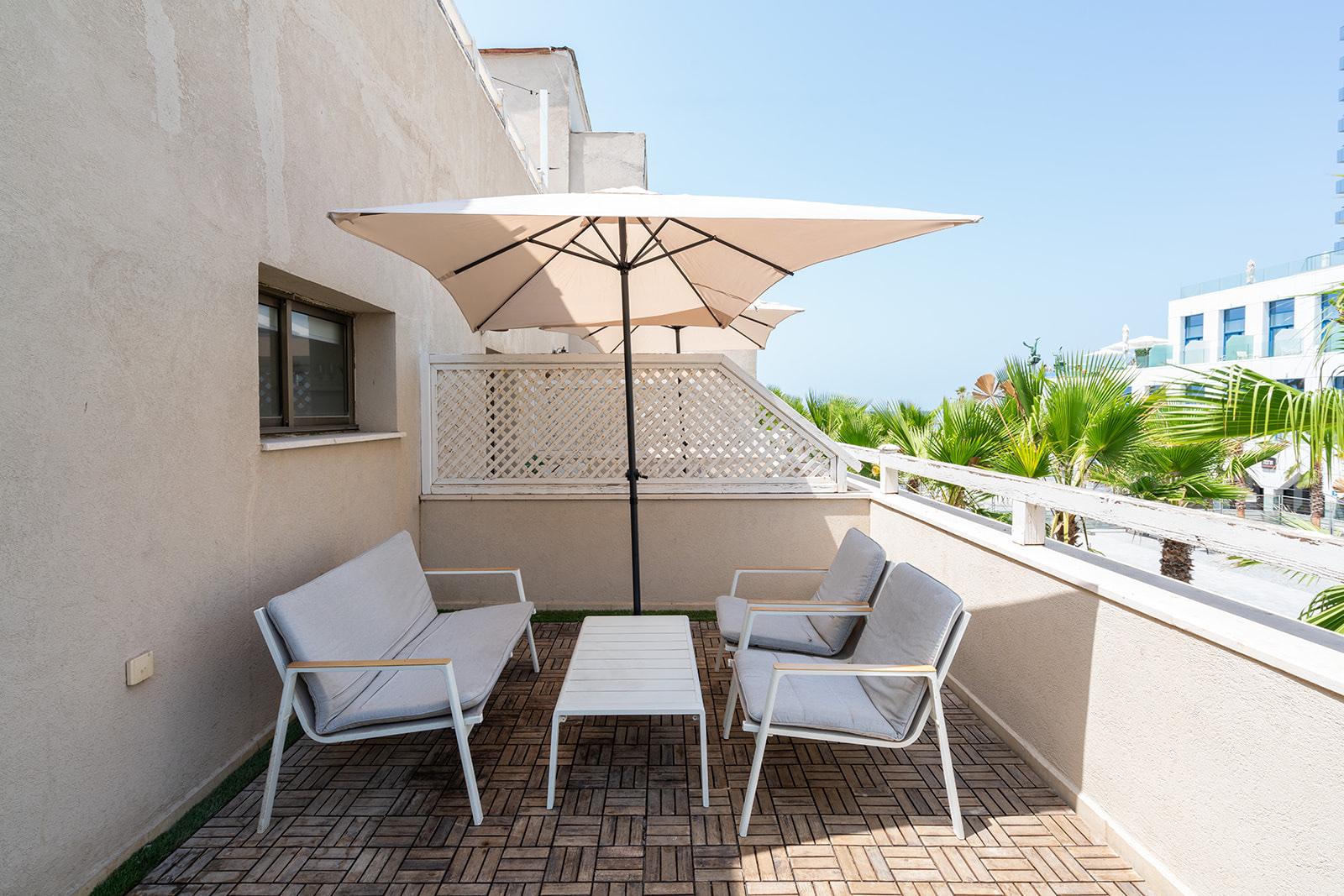
Our renovated building on the beachfront side of HaYarkon Street puts the White City, the beach and Carmel Market all within easy walking distance — a natural base for exploring Tel Aviv on foot. Our ten serviced studios range from 22 to 34 m², some with sea-view balconies, and share a rooftop that's ideal after a long walk. Rates are available on request; we'd be happy to help you plan your stay.
Stay at 45Beach
Ten studios one minute from the beach.